“Changjiang Cup” Global AI Protein Design Challenge
The target announcement is coming soon!
This year’s challenge will focus on VHH and minibinder design.
The MatwingsVenus® platform now offers a complete design and validation workflow for both task types.
As a sponsor and supporting partner of the competition, Matwings will provide every participant with:
- 100,000 platform credits for MatwingsVenus®
- A RMB 100 Token voucher for the newly launched MatwingsVenus® Token platform
The Token platform supports models including GLM-5.3-flash and DeepSeek-V4-Flash-1017, as well as AI coding tools such as DeepSeek Harness, Pi Agent, Codex, Claude Code, and CC-Switch.
Whether you want to streamline your de novo protein design workflow or are exploring AI protein design for the first time, MatwingsVenus® provides the tools and computing resources to support your work.
In the days ahead, we’ll also be releasing a series of tutorials on de novo protein design with MatwingsVenus®.
We look forward to seeing your designs at the Changjiang Cup!
Try MatwingsVenus® for free https://matvenus.com/
Register for the MatwingsVenus® Token platform https://token.matvenus.com/

01 Exclusive Credits for Changjiang Cup Participants
Starting today, the MatwingsVenus® platform is offering 100,000 complimentary platform credits to every Changjiang Cup participant. Both team leaders and team members are eligible to claim the credits for design and computation throughout the competition.
How to claim your credits
- Scan the QR code below and enter the email address used for competition registration.
- A credit redemption code will be sent to that email address—please check your inbox.
- Register or log in to MatwingsVenus®: https://matvenus.com/
- Please do not enter the redemption code in the invitation-code field during registration.
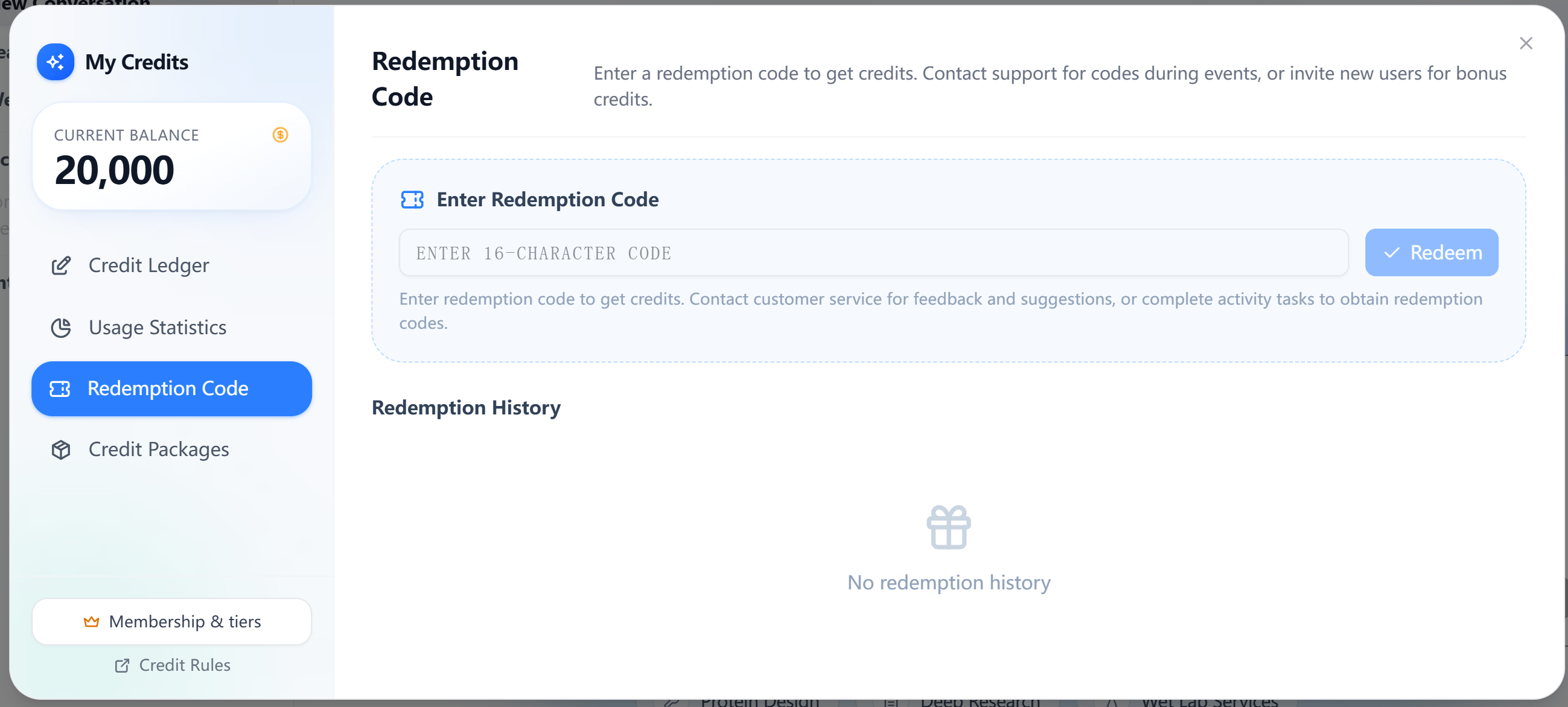
- Click your profile avatar in the lower-left corner and go to My Credits → Redemption Code. Enter the code you received.
- Your credits will be added instantly and are ready to use for your competition designs.
02 Exclusive Token Support for Changjiang Cup Participants

The newly launched MatwingsVenus® Token platform is offering every Changjiang Cup participant RMB 100 worth of complimentary LLM Tokens for models including GLM-5.3-flash and DeepSeek-V4.1-flash-1017. Both team leaders and team members are eligible to claim the Tokens.
How to claim your Tokens
- Visit the MatwingsVenus® Token platform at https://token.matvenus.com/ and register or log in with your mobile number.
- Scan the QR code below and submit the email address used for competition registration, along with the mobile number registered on the MatwingsVenus® Token platform.
- The Tokens will be credited to your account within 24 hours.
If you encounter any issues with registration or claiming your platform credits or Tokens, please scan the QR code to add our official WeChat support account or join the official community group. We’ll be happy to help.
03 MatwingsVenus® Platform Capabilities at a Glance
For this challenge’s VHH nanobody and minibinder design tasks, MatwingsVenus® provides an end-to-end workflow spanning:
target research, structure preparation, and sequence design, through to structural validation and interface evaluation.
The platform supports every stage of the design process—from initial design and validation to iterative optimization.
Target Research
Before starting the design process, participants can use MatwingsVenus® to verify target information and conduct background research on the organizer-provided target. Available resources cover sequence and functional annotations, 3D structures, known binders and ligands, interaction and interface evidence, as well as relevant literature and patent searches.
| Research Objective | Platform Resources |
| Target identity and sequence | UniProt, BLAST, Foldseek |
| 3D structure | PDB / PDBe, AlphaFold DB |
| Known binders and ligands | BindingDB, ChEMBL, Open Targets |
| Interactions and interfaces | BioGRID, STRING, PDB |
| Literature | PubMed, arXiv, Semantic Scholar |
| Patents | PatSnap |
Structure Preparation
- Convert between commonly used structural file formats, including CIF/PDB and SDF/MOL2/PDBQT.
- Prepare structures with hydrogen addition, pH-based protonation, structure trimming, and more.
VHH Nanobody Design Capabilities
MatwingsVenus® offers two complementary VHH design workflows, allowing users to choose the approach that best fits their available structural information and design goals.
| Design Approach | Tool | Workflow |
| De novo VHH generation | mBER | Generates candidate VHH sequences and structures directly against a target antigen, without requiring an existing antibody framework. |
| Framework-guided CDR design | RFantibody | Designs and optimizes CDR regions based on a provided FR1–FR4 framework, and outputs candidate structures using IMGT/Chothia numbering conventions. |
Minibinder Design Capabilities
MatwingsVenus® supports three leading de novo binder-design workflows:
| Design Approach | Tool | Workflow |
| Scaffold generation and sequence design | RFdiffusion 1/2, ProteinMPNN, LigandMPNN | Generates candidate binding scaffolds against a target protein, followed by sequence design. LigandMPNN supports designs involving ligands, metals, or cofactors. |
| Joint scaffold–sequence design | BindCraft | Uses AlphaFold2-based structure generation and sequence optimization, then filters candidates using interface-quality and related metrics. |
| Constraint-guided generative design | BoltzGen | Generates candidate complex structures from the target structure, binding site, or other design constraints. |
Structure Prediction and Docking
| Validation Need | Tool | Key Metrics / Use Cases |
| All-atom structure prediction | VenusFold | pLDDT, PAE, and structural consistency |
| Protein complex prediction | AlphaFold2 (Multimer) | ipTM, pTM, pAE, and interface confidence |
| Rapid initial screening of monomer folding | ESMFold | Folding confidence |
| Multi-entity complex prediction | Protenix | Structure prediction for complexes involving proteins, ligands, nucleic acids, metals, and more |
| Protein–protein docking | HDOCK, ZDOCK | Binding poses and interface consistency |
Interface Analysis and Computational Optimization
| Tool | Capabilities |
| PLIP | Automatically identifies hydrogen bonds, hydrophobic contacts, salt bridges, π-stacking interactions, halogen bonds, and water bridges. |
| PyMOL | Creates publication-quality interface maps, hotspot maps, surface renderings, cartoon representations, and more. |
All of the antibody-design tools featured above are now available on MatwingsVenus®.
We are building a lightweight, intuitive AI platform for life-science research and design.
The tools are ready, and our tutorial series is coming soon.
Explore MatwingsVenus® today—we look forward to seeing your designs at the “Changjiang Cup”!
- Disclaimer: Intellectual property rights to protein design sequences and related results generated using MatwingsVenus® belong to the user or the user’s team. Users are solely responsible for the use, publication, and commercialization of their inputs and generated results. All structures and scores produced by the platform are computational predictions and do not guarantee experimental outcomes or commercial performance. For participants in the “Changjiang Cup,” intellectual-property ownership and use of competition entries are subject to the official rules issued by the competition organizers.