
At a time when nearly everyone chases careers in general artificial intelligence and high-paying roles at big tech firms, why would an award-winning computer science PhD student with a strong publication record voluntarily leave the well-trodden mainstream tracks of natural language processing and computer vision to dive into the unfamiliar terrain of biological research?
Tan Yang is the lead developer of MatwingsVenus™ (Xiaowu™), the conversational protein R&D agent named WAIC 2026's "Signature Exhibition Treasure" — the event's highest honor for showcased products.
His cross-field pivot into AI for life sciences began with a simple, personal promise to family.
01. Can my technical expertise actually help real people?
After his grandmother was diagnosed with Alzheimer's disease, Tan first began to question his career path: no matter how well he wrote code, how could it solve tangible, real-world problems? The monoclonal antibody therapy his grandmother was prescribed inspired him to step outside his familiar computer science lane, enter the protein R&D field, and explore how AI could advance life science research.
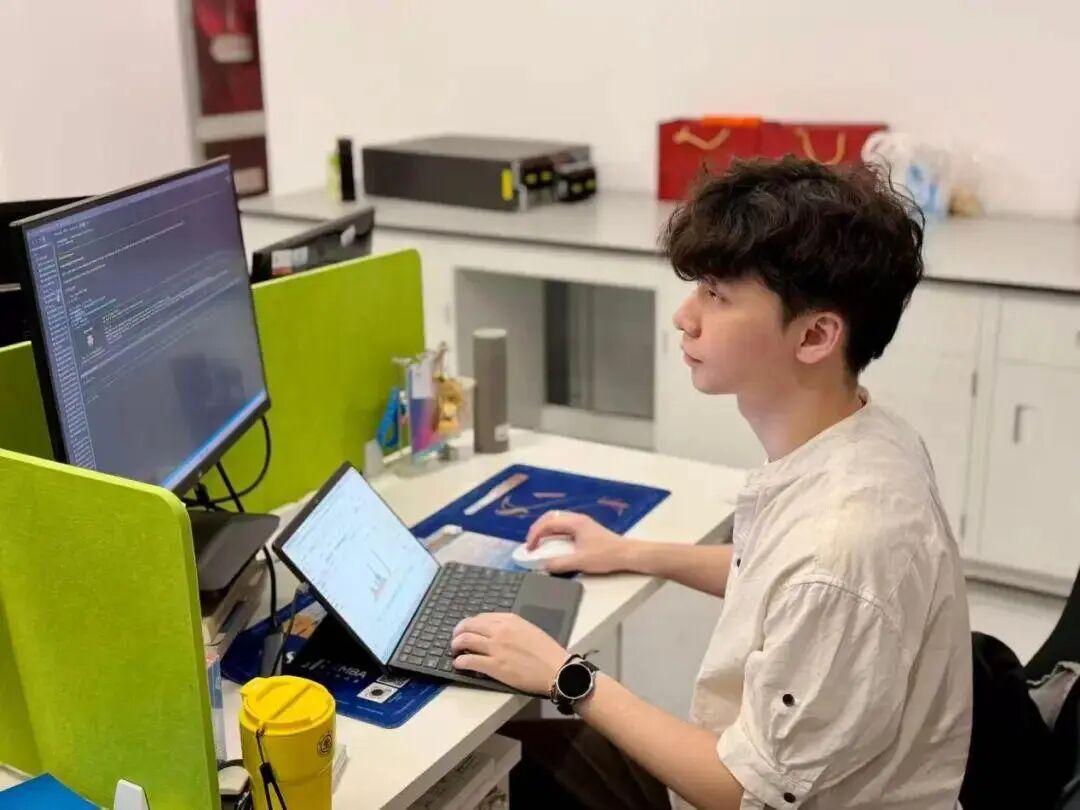
Entering the entirely new domain with zero prior biology background, he built an early self-developed model prototype that boosted the activity of the Cas12i3 enzyme fivefold in a short period. This breakthrough convinced him that AI could overhaul traditional research paradigms and solve long-standing R&D bottlenecks in the life sciences.
But individual, isolated breakthroughs have limits. For technology to move beyond academic papers into real-world impact, it requires systematic support and cross-functional team collaboration. In Matwings Technology' open, research-driven culture, supported by the company's real-world industrial datasets and domain expertise, Tan's original vision took root and grew: his scattered early algorithm prototypes iterated into today's full-stack AI protein R&D platform, delivering real, deployed technology that addresses core industry needs.
.jpg)
02. Making protein R&D less inaccessible
For decades, protein R&D has been plagued by long development cycles, exorbitant trial-and-error costs, and high barriers to industrial translation. Even AlphaFold, the 2024 Nobel Prize-winning breakthrough, only solves the foundational problem of "visualizing protein structure" via structure prediction — it cannot support the functional development needs of industrial applications.
The MatwingsVenus™ large model makes the critical leap from "structure prediction" to "functional creation": it can directly predict and design protein functions from sequence data, directly addressing the core industry demand for practical, deployable solutions. This is the defining innovation that sets it apart from other AI protein tools currently on the market.
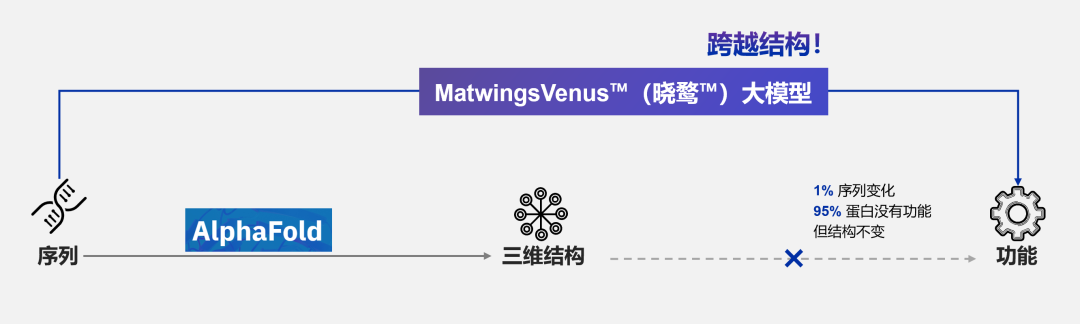
Leveraging this differentiated, proprietary technology stack, Xiaowu has fully rebuilt the protein research paradigm:
- World-leading accuracy: Trained on a dataset of tens of billions of annotated protein sequences, the model has long held first place on Harvard Medical School's ProteinGym protein engineering benchmark.
- Full-stack dry-wet closed loop: The platform supports protein design via natural language prompts, directly connecting to Matwings' proprietary lights-out automated laboratory for experimental validation. It delivers a one-stop, end-to-end workflow for protein design, experimentation, and iterative optimization, drastically lowering barriers to entry for protein R&D.
- 10x efficiency gains: Development cycles are compressed from the traditional 2–5 years to just 2–6 months, delivering dramatic cost reduction and throughput improvements.
- Proven industrial deployment: To date, Matwings has delivered over 40 successful protein engineering projects, with more than 10 projects already operating at scaled production. Applications span real-economy sectors including innovative pharmaceuticals, health and wellness, and circular economy, delivering tangible translation of lab technology to industrial impact.
.jpg)
A Gen Z wunderkind who broke cross-disciplinary boundaries to take the top stage at WAIC. At Matwings Technology, young talent is the fresh driving force unafraid to break new ground. We always look forward to walking alongside passionate, purpose-driven young researchers to build the long-term future of AI for the life sciences.
Biography: Tan Yang
.jpg)
Born in 2000, Research Scientist at Matwings Technology AI Lab, lead developer of the dialogue-driven protein R&D agent MatwingsVenus™ (Xiaowu™). He is currently a 2025 cohort joint PhD candidate at Shanghai Jiao Tong University and the Shanghai Chuangzhi Institute. He was selected for the 2025 China Association for Science and Technology (CAST) Young Talent Doctoral Training Program, and has received more than 20 provincial/ministerial-level and above awards including multiple National Scholarships. He has published 13 papers as first or co-first author at top conferences and journals including NeurIPS, ICLR, and eLife, with 26 total publications and over 600 citations. He serves as a reviewer for venues including Nature Machine Intelligence, ICML, and ICLR. His research outputs rank first on Harvard Medical School's ProteinGym protein engineering benchmark; his open-source models and datasets have accumulated over 300,000 downloads on Hugging Face. He also contributed to development of Shanghai Jiao Tong University's Venus series large models and the Zhaoyan large model of the Shanghai-Chongqing Artificial Intelligence Research Institute.